Showing posts with label Sparring. Show all posts
Showing posts with label Sparring. Show all posts
Saturday, May 11, 2013

Friday, July 15, 2011
An Introduction to MMA Sparring - Closing Thoughts
by Bill Easlick
This post on the "Introduction to MMA Sparring" topic is really just my final thoughts and an attempt to wrap up for any loose ends and questions that people have asked me about my posts.
"Bill I wanted to know how you connect the appropriate sparring gear to the levels of sparring contact and the sparring methods you use in your classes."
Great point, and this is something that I planned on addressing, so here goes.
L - Light Sparring
M - Medium (Controlled) Sparring
H - Hard Sparring
* - Special scenarios or conditions
"Hey Bill, in my gym we wear headgear when we spar. Why don't you?"
- I think I covered my thoughts on headgear pretty well in my equipment article. If someone wants to wear it, I'm completely cool with that, but ironically, I'll almost expect that people will be striking extra hard at this person's head. Like a moth to a flame; it's just our nature.
"Isn't it silly to give a % of contact used in sparring ?"
- I think it is when you're talking about things like 40% vs. 60% etc, but in my articles, I tried to be as clear and descriptive as possible and each was tied to more "instinctual" feelings rather than a meaningless percentage.
"I can't get my sparring partners to slow down when doing "light sparring" Every round ends up sparring hard."
I know. Sucks right? As I mentioned in the article, I believe this is the hardest area to teach new students and others may pshaw it, but I think their problem lies in ego (whether they realize it or not). It requires, no, demands a removal of ego. Both partners have to let go of winning and losing and play the skill game: striking with good intent, but at a slower pace to keep the contact down. People don't like to lose, and their ego says "aww hell nah!" and they raise the speed and contact level until they're on top again, completely missing the point - creativity, developing reactions and building "fight intelligence" (more on that process in an article I'm already working on.)
This post on the "Introduction to MMA Sparring" topic is really just my final thoughts and an attempt to wrap up for any loose ends and questions that people have asked me about my posts.
"Bill I wanted to know how you connect the appropriate sparring gear to the levels of sparring contact and the sparring methods you use in your classes."
Great point, and this is something that I planned on addressing, so here goes.
Standup | Clinch | Ground | |
Cup | L/M/H | L/M/H | L/M/H |
Mouthguard | L/M/H | L/M/H | L/M/H |
Headgear | H* | - | - |
Boxing Gloves | M/H | H | - |
MMA Training Gloves | L | L/M | L/M/H |
Shinguards | L/M/H | - | - |
L - Light Sparring
M - Medium (Controlled) Sparring
H - Hard Sparring
* - Special scenarios or conditions
"Hey Bill, in my gym we wear headgear when we spar. Why don't you?"
- I think I covered my thoughts on headgear pretty well in my equipment article. If someone wants to wear it, I'm completely cool with that, but ironically, I'll almost expect that people will be striking extra hard at this person's head. Like a moth to a flame; it's just our nature.
"Isn't it silly to give a % of contact used in sparring ?"
- I think it is when you're talking about things like 40% vs. 60% etc, but in my articles, I tried to be as clear and descriptive as possible and each was tied to more "instinctual" feelings rather than a meaningless percentage.
 |
| You weren't expecting a Will Smith reference! |
I know. Sucks right? As I mentioned in the article, I believe this is the hardest area to teach new students and others may pshaw it, but I think their problem lies in ego (whether they realize it or not). It requires, no, demands a removal of ego. Both partners have to let go of winning and losing and play the skill game: striking with good intent, but at a slower pace to keep the contact down. People don't like to lose, and their ego says "aww hell nah!" and they raise the speed and contact level until they're on top again, completely missing the point - creativity, developing reactions and building "fight intelligence" (more on that process in an article I'm already working on.)
The best advice I can give you is to try to find like-minded partners who understand your goal. (Send them the link to my articles if you think it will convey the message to them!) And remember, almost everyone will get worked up at some point, even the experienced guys. The difference is they realize it, reset, and go back to the methods. I'm very fortunate that I had a core group of my first students come up under this approach, and as they advance they mentor the new students and now it's just part of our training "culture" at Fairfax Jiu-Jitsu.
Thanks for reading,
-Bill
Thanks for reading,
-Bill
Thursday, April 28, 2011
An Introduction to MMA Sparring - Part 2.
by Bill Easlick
( I'm Sorry for the delay. I know many of you were looking forward to a PROMPT follow-up to my last blog article and I sincerely apologize for the delay. Life has been kicking my butt lately! My day job; My family; Preparing some of our fighters for MMA fights; Travel; Seminars ; etc., all take precedence over my blog writing. In the future I plan on writing smaller and much more frequent updates. Mea culpa...)
Transitions
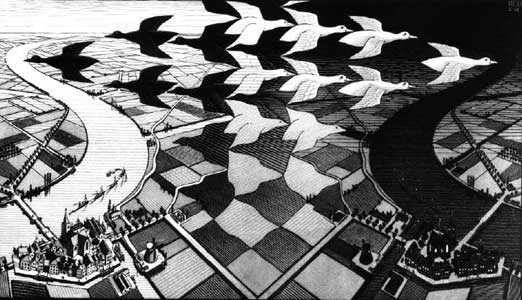 |
| M.C. Escher understood the artistry of the transition. Seamless transitions put the "art" into Martial Artist. |
One of the most important things in being a successful MMA fighter today is being able to transition between ranges and tactics, but yet I’m always very shocked when I look at other gyms and see how many fighters are still training without transitions in their sparring. Many gyms still train boxing or muay thai for striking, train wrestling or judo (maybe) and train no gi BJJ/submission grappling; each as individual and sport-specific classes. That is not MMA folks! In my opinion there is a better way.
The problem with that approach to training lies in the lack of transitions that occur in each of those sports. Each has a fairly limited rule set and techniques compared to MMA, and their training is always done within those rules.
For example:


- A fighter goes to boxing class and he works on striking another like-minded striker to the head and body with his hands. There are no kicks, no knees, no elbows, no clinch, and certainly no fear of getting wrestled to the ground.
- A fighter goes to BJJ class where he spars with another submission-oriented opponent in an attempt to choke or joint lock each other. There may or may not be takedowns, and there is no striking.
Is that the best way to spar for MMA? Absolutely not. A modern MMA fighter must be able to transition, flowing smoothly and technically from different aspects of the fight. The fighter needs to train a transition as an actual sport-specific skill. He needs to integrate these separate arts into his MMA training, not specialize and compartmentalize them in isolation, otherwise he will never "bridge the gap" between techniques with success.
*(Please note that I fully understand that there is a time when a MMA fighter needs to train in sport-specific areas of his game, but for the novice-amateur fighter, this training should be supplemental to his fundamental MMA training if he's part of a well-rounded complete program. This will be the topic of another blog, much sooner this time, I promise!)
- To be able to strike effectively in MMA, a fighter must be able to stay on his feet and control the free standing position, which can be very difficult because this often means his success in striking (and the damage it causes) will often cause his opponent to attempt to clinch or take him down to nullify the strikes. A MMA striker must be able to clinch and counter wrestle.
- To set up a shot, a fighter must be able to time his opponent’s strikes or create his own pressure by throwing strikes to set up the shot. He must also be able to transition from the takedown into ground work as well without putting himself in poor position to get submitted or swept.
- To end the fight in a submission, the fighter must get the fight to the ground and will need to make several transitions through the standup and takedown phases in order to get the fight to the ground putting him in a favorable leverage position.
"So how do I spar for MMA?"
So you can see that as a MMA fighter, it's critical to learn and train transitions. Including transitions in your sparring training to make each fighter work their skills in the format that closest resembles how they will actually fight. To do so we divide all of our MMA sparring at Fairfax Jiu-Jitsu into 3 major categories.
Techniques: kicking, punching, knees, clinching, dirty boxing, takedowns, throws, standing cage tactics
Transitions: boxing and kickboxing striking and standup grappling including muay thai clinchwork, greco and judo and wrestling
Format: Fighters spar using almost all of their skills available on their feet including strikes clinched knees, pummeling, dirty boxing, takedowns (shots) and throws. The "action" does not stop until the round ends or someone is taken down and there is a clear position achieved. - Standing, side control, guard, back etc., in which the fighters will stop and reset standing again.
 |
"Be like water" - Bruce Lee
|
This is the launch pad for all of our striking and for much of our clinching and wrestling skills in MMA. This is where our students begin to fully understand the relationship that striking and grappling have. You're a good striker? Try it against someone actively seeking to take you down (ie. BJJers and wrestlers - 2/3rd of the people you may encounter). You're a good wrestler? Try it against someone who is going to punch or knee you as soon as you move towards them.
What changes? - the transitions of course! Setting up your takedown, timing a strike, the amount of pressure you give your opponent, making the level change, throwing a knee in the clinch, etc. Dozens, if not scores of tactics unique to MMA must be addressed to succeed on your feet in MMA.
Dirty Boxing/Clinch -
Techniques: knees, punches, clinch, takedowns, throws, standing cage tactics
Transitions: striking and standup grappling including muay thai clinchwork, greco and judo and wrestling
Format: Fighters begin in a neutral clinch position (ex. Over/Under or a Collar Tie/Bicep) near the cage wall or padded wall and work to these to strike and position into control and or a takedown
Hey..Wait a minute!.. Isn't this just a sub-set of the standup sparring? Yes it is (see if your students/fighters figure this out), but over the years I've found that it is so important that it's worthy of it's own sparring time during training for two important reasons.
 The frequency that two fighters will find themselves in the standing clinch should make it an area that every fighter should be comfortable and knowledgeable. The standing clinch is often the gateway in a fight. - the fighter who can control the clinch often decides where the fight occurs - continuing to fight on their feet, or down on the ground - transition! This is exactly why we focus on this sparring, working on the balance of strikes and control to score.
The second reason is the proximity of the cage and it's importance in sparring. The cage is a game changer! This full length physical barrier has major impact on positional control, takedown defense and movement. All MMA fighters need to train on the wall; both offense and defense and all the transitions in between. (this goes for all 3 formats)
Speaking of transitions.. When you begin to spar in this format you will notice another type of transition that's very sport-specific to MMA -The transitions of the clinch itself, flowing from pummeling and positional control to striking. In any given minute you could go from a Greco bodylock, to an underhook and straight arm pike to the face into a Muay Thai knee into another pummel battle into a Judo inside leg trip, etc., etc., in an infinite loop and combination of techniques. This is unique to MMA and why we say that there is not a "muay thai clinch" or a "wrestling clinch" in our program, it's just "the clinch".
Groundwork -
Transitions: Positional grappling with striking
Format: Fighters can begin in various positions to begin to work groundwork positions attempting various goals including, submissions, strikes, reversals, and escapes
One of the most common, and obvious shortcomings is not being adept at defending punches being thrown by a person who may be more than willing to remain inside their guard or a side control position as long as they are causing damage and winning in the eyes of the judges.

This has a major impact on the guard position in MMA. Brazilian Jiu-Jitsu blackbelt Mark Jones had this to say about the guard in MMA. "The rules of each sport (BJJ and MMA) have made the complexities of the guard serve different purposes. The guard work of MMA has to be more functional. Keeping tight when in danger, getting back on to your feet or capitalizing immediately when opponent makes a mistake in the top position."
On the other top side of this position, a fighter must also learn how to maintain posture and pressure to strike, safely avoiding submissions and sweeps and use striking to setup his transition to a better position such as passing the guard. He must learn to balance striking with positional control or the referee will stand the fighters back up.
Mark brings up a very MMA-critical skillset that is trained in this area - standing up and disengaging from groundwork. As mentioned at the beginning of this article, the goal of isolated sparring is often narrowly defined. In fact, disengaging from your opponent in BJJ is frowned upon, however, in MMA, learning how to get back to your feet while avoiding damage could change the fight, particularly for a striker.
One of the biggest transitions we work in groundwork is the starting position. While we feel that a fighter should know how to fight from every position on the ground, it's important that he works on perhaps one of the most critical position in MMA - taking someone down and maintaining control after the takedown to enter groundwork in the dominant position. To do this we'll often begin groundwork sparring from our feet with a "no strikes until someone hits the ground" guide. This puts the pressure on each fighter to get the takedown and start the sparring in the dominant position (and keep it).
These are the 3 types of sparring that we do do develop our fundamental MMA skills on our team. Each of these formats integrating a major transition in their sparring which is key for success as a MMA fighter.
Thanks for reading, I hope you enjoyed the blog article and I promise that I will switch to smaller and more frequent posts in the future. As always, I'd like to hear any comments or questions you have about my writing. I am not the final word on this subject, This is just my opinion based on my experience as a student, fighter and coach. Thanks.

This has a major impact on the guard position in MMA. Brazilian Jiu-Jitsu blackbelt Mark Jones had this to say about the guard in MMA. "The rules of each sport (BJJ and MMA) have made the complexities of the guard serve different purposes. The guard work of MMA has to be more functional. Keeping tight when in danger, getting back on to your feet or capitalizing immediately when opponent makes a mistake in the top position."
On the other top side of this position, a fighter must also learn how to maintain posture and pressure to strike, safely avoiding submissions and sweeps and use striking to setup his transition to a better position such as passing the guard. He must learn to balance striking with positional control or the referee will stand the fighters back up.
Mark brings up a very MMA-critical skillset that is trained in this area - standing up and disengaging from groundwork. As mentioned at the beginning of this article, the goal of isolated sparring is often narrowly defined. In fact, disengaging from your opponent in BJJ is frowned upon, however, in MMA, learning how to get back to your feet while avoiding damage could change the fight, particularly for a striker.
One of the biggest transitions we work in groundwork is the starting position. While we feel that a fighter should know how to fight from every position on the ground, it's important that he works on perhaps one of the most critical position in MMA - taking someone down and maintaining control after the takedown to enter groundwork in the dominant position. To do this we'll often begin groundwork sparring from our feet with a "no strikes until someone hits the ground" guide. This puts the pressure on each fighter to get the takedown and start the sparring in the dominant position (and keep it).
These are the 3 types of sparring that we do do develop our fundamental MMA skills on our team. Each of these formats integrating a major transition in their sparring which is key for success as a MMA fighter.
Thanks for reading, I hope you enjoyed the blog article and I promise that I will switch to smaller and more frequent posts in the future. As always, I'd like to hear any comments or questions you have about my writing. I am not the final word on this subject, This is just my opinion based on my experience as a student, fighter and coach. Thanks.
Tuesday, February 15, 2011
An Introduction to MMA Sparring - Part 1
by Bill Easlick
Over the years I’ve seen a lot of confusion and some misconceptions about how we spar in Mixed Martial Arts (MMA) training and I’d like to give my own philosophy and experience on this subject to help potential new students and help more advanced athletes as well, who may not have seen all of the possibilities. I’ve broken this blog article on sparring into two digestible posts to help clarify my thoughts and intentions to the reader.
Over the years I’ve seen a lot of confusion and some misconceptions about how we spar in Mixed Martial Arts (MMA) training and I’d like to give my own philosophy and experience on this subject to help potential new students and help more advanced athletes as well, who may not have seen all of the possibilities. I’ve broken this blog article on sparring into two digestible posts to help clarify my thoughts and intentions to the reader.
“You fight like you train.”
 When you think of MMA, you can’t help but think of its intense, exciting history and the testing of different martial arts against each other that led us to the present evolution. I think most people can agree that regardless of style, what worked well in early MMA events were combat sports, which regardless of style spend a large amount of their training practices focusing on sparring. Sparring clearly has a direct translation to fighting regardless of style.
 People who have been training, even for a short time, all know that sparring is important, but when I ask them a simple question – “Why is sparring important?” I get a confused look, or a shrug and a smile from them. It’s clear to me that sparring is something that has to be experienced to be fully understood by the new student. We call it “physical enlightenment”. A friend of mine calls it “the baptism”. I think it’s no surprise both of those references have a spiritual connotation.
Author Dan Millman wrote, "Understanding is the one-dimensional comprehension of the intellect. It leads to knowledge. Realization is three-dimensional - a simultaneous comprehension of head, heart, and instinct. It comes only from direct experience."
The first time that someone participates in sincere sparring, they go from the theoretical to the living; From what they "think" they know, to what they can actually perform. Sparring is the main vehicle that transfers static techniques learned in class, into real fighting skills.
By “real”, I mean that sparring teaches the timing, movement, and resistance that no amount of pre-patterned movements or a cooperative partner will ever give them. (Watch early UFC’s to see this in application when combat sports athletes fought traditional martial artists.) Someone can practice a jab in the mirror or thousands or repetitions on a heavy bag or wooden dummy or even against a compliant partner who knows the jab is coming, but until they can actually deliver the jab while sparring against someone trying to avoid their strikes, (and counter) they have not integrated that skill into their fighting and when the stress and contact level of sparring rises, the skills they can rely on will narrow to their most engrained, most successful techniques. (We'll talk about this thought later.)
The thought or perception of MMA sparring can be intimidating to many novice students, particularly those who do not have a background in contact sports like wrestling, football, rugby, or combat sports. I sometimes wonder if they imagine that we just put on our fight gloves, put in a mouthpiece and start banging on each other until someone falls down, taps out, goes limp, etc. Maybe the new guys have to mop up the giant pools of blood? – Got to keep those mats clean! ;-D
Here is my attempt at describing and clarifying some of the methods and objectives that allow my students to maximize the potential of sparring in our MMA training.
Ever hear someone say, “At my gym, we spar at 100%!” ?
I'm actually surprised at how frequently I heard this phrase from people on MMA-related message boards and I believe I understand their meaning despite what they actually said. To me, this is the classic case of mistaking intent vs. contact in sparring.
Intent is your sincere effort to apply your techniques in sparring. This can relate to nearly every phase of fighting from striking to groundwork. If you are sparring with a partner and working on striking and giving your best effort to use good footwork, block and evade his strikes while trying to apply your own offense, or using your best technical ability to apply a submission from a dominant position, This is sparring with 100% intent.
Contact is the delivery of the techniques. This is not only applicable to striking, but to all phases (clinch, wrestling, groundwork). ex. You intend to jab your training partner in the chin, how hard you hit him is a measure of contact. You may intend to tap your partner with an armbar, how quickly you hyperextend his elbow is a measure of contact.
So hopefully you can now imagine that sparring partners can be working with 100% intent, but using various levels of contact ranging from light sparring, to nearly "fight-level" sparring.
Here is how I use levels of intent and contact to create the optimal sparring for MMA training.
Light Sparring -
This is the "laboratory" of sparring. The focus of this sparring is the testing of MMA skills. The contact level is no more than roughly 50% of your maximum effort. The speed at which you should spar should be no more than 75%.
It is very important to remember how closely speed is related to power, particularly in striking sparring. (Power = the mechanics of your strike x the speed at which you use it) So if you strike at full speed, you're still producing the potential for very hard contact.
Unfortunately the variable that most people try to change is the intent, but when they reduce the intent to maintain safety at full speed, they create bad technique. Instead, if they reduce the speed of the sparring slightly, each sparring partner can still spar with full intent, attempting to landing strikes to the desired targets instead of lowering the level of intent and "pulling" punches and creating a false sparring session, improper range and poor defensive skills. In my opinion this is actually one of the hardest sparring levels to do well, not because of the lighter contact, but because of the reduced speed. Novice MMA students tend to go faster when nervous or pressured. Sometimes a student goes too hard or fast after his ego is bruised. How many times have we heard the infamous line in BJJ sparring, "Let's roll light.", where students agree to roll lightly, then quickly change to a quicker, higher level of contact once one person gets put into a bad position or tapped out.
There is a time for ego in training, but it's not in light sparring. Light sparring is about experimenting and taking chances. It's about learning how to succeed and learning how to fail. The student should feel safe knowing that if he goes for something and it doesn't work for him, the consequences won't smash him. If a student is always worried about the consequences of making a mistake, they'll stop taking chances, their MMA skills won't expand and their learning process will stagnate. Light sparring can show you that if you try something new it might work, and it might not, and when it doesn't you can find out why and then learn how to correct yourself or even counter the counter! This is the very definition of skill development and why it is such an important part of proper MMA training at all levels of experience.
Here's an example of some of my students engaging in light sparring for MMA. Notice the use of a large array of MMA skills - boxing, kicking, knees, throws, takedowns, even a "slam", yet all was done in a controlled manner. No one was getting "crushed" and everyone was working on being skillful.
Here is an another example of two Fairfax MMA students, both active fighters, practicing light sparring.
Here is another example of light sparring with a focus on grappling. This one features Ryan Hall in the green t-shirt, rolling with the reknown BJJ phenom Marcelo Garcia. A beautiful smooth flow. Both men left their ego's behind and took chances.
This is the base of our MMA sparring training. When most expereinced combat sports athletes and coaches are referring to "sparring", this is the level we have in mind. The contact level is no more than roughly 75% of your maximum effort.
"How do I measure that?", is the commonly asked question that follows that definition. The answer is "Control". In this particular context, control is the mindset that we are not going "all out" with 100% contact. We are using full intent and speed, but we are being mindful not to harm our training partners. The goal is to land your punch, not cause a knock out, or to apply a joint lock or choke but give your opponent time to tap and avoid injury. I can usually convey the objectives of this sparring in those two simple sentences. For people who have already trained in the grappling combat sports like wrestling, bjj, judo, or sambo, this is already the "de facto" method of sparring.
While I've seen this method of sparring used since I was in grade school on the wrestling mats, I've never had anyone define it or explain the mental side of this sparring until I began to study judo and learned that the founder, Dr. Jigoro Kano, based his entire art on two simple, yet profound principles. Maximum efficiency and Jita-Kyoei - the perfection of one's self and mutual welfare and benefit. It is this second principle that really speaks to this form of sparring. Sparring should bring out the best in both training partners. If one of them is harmed during sparring due to excessive contact, they're both losing the benefit of sparring training. One is now injured and cannot train and one has lost a skilled partner to train with, whether by injury or mentality (No one wants to train with the jerk that intentionally hurts people) which means he/she has fewer partners that will help them grow. Instead, spar with skill and control. Focus on strategy and techniques, timing, etc. Respect for fellow training partners is crucial in MMA for a successful career.
Hard sparring –
This form of sparring is by far the most contact that we use in MMA training. I would categorize the contact level to be > 95%. The reason it is not 100% is because this is sparring, not a fight. There should always be some level of control, even if only mental to control your emotions, avoid late hits, and foul tactics etc.
Hard sparring is practically diametrically opposite of the Light sparring described above. In Light sparring, the objective is the focus on technical skill and the contact is kept light to keep relaxed, but for Hard sparring, the contact is extremely high and this causes the technical skill level of the sparring to often be much lower than the MMA student actually has the capacity of using. This is due to the effects of the increased pressure of Hard sparring - the adrenaline is raised, the muscles are more tense, and the person is relying on their "go-to" movements the things that they can do under pressure without much thought involved. Fighters enter "Survival Mode".
The objective of Hard sparring is not the refinement of skill, it is about the culmination of mental toughness and physical conditioning. In our gym, only one group of students uses this type of training with any regular frequency (more than once a week in our gym) -Athletes preparing for an upcoming fight. All other times our sparring is Light or Medium level sparring.
Hard sparring is where rubber hits the road for serious MMA fighters. The jump from the recreational MMA student to the competitor. Someone can be a technical wizard and have the conditioning of a machine, but if he/she doesn't have the internal fortitude, they can lose the fight when put in a tough situation.
Hard sparring is the time for the ego in MMA training. Now is the time for a theme song or a great quote to bring out his/her potential. They're going to get hit and keep going, they're going to get taken down and must get back up. They're going to get mounted and must survive and reverse the postion. They will not give up and they will not give in. The heart of a champion.
David Jacobs, a Brazilian Jiu-jitsu Blackbelt and very well known for his impressive competition record, says this when asked about how to use ego in training: "When you are learning techniques, practicing them, and experimenting, you have to minimize your ego. On the other hand, when it's time to get ready for competition, you need to toughen up and tighten up and be the king of the mat!" Dave calls this ability "performance on demand", and it's a perfect description of how a competitor needs to train.
Please understand that I'm talking about the use of ego in a positive, productive way. Don't let the negative side of ego into your training. Stay humble and focused when you step off the mat/ring/cage. Everyone gets hit. Everyone taps out. What matters is how you learn from it and continue to move forward. That's character, and in the end, that may be the greatest lesson the martial arts give us.
In Part 2 of of this Sparring for MMA blog, I'm going to talk about actual methods and systems we use at Fairfax Jiu-Jitsu for developing specific objectives and the appropriate equipment and levels of sparring for each.
Thank you very much for reading. As always, please feel free to give feedback. I completely understand that my opinion is not the final word on these topics, just simply my own experience.
Hard sparring is where rubber hits the road for serious MMA fighters. The jump from the recreational MMA student to the competitor. Someone can be a technical wizard and have the conditioning of a machine, but if he/she doesn't have the internal fortitude, they can lose the fight when put in a tough situation.
Hard sparring is the time for the ego in MMA training. Now is the time for a theme song or a great quote to bring out his/her potential. They're going to get hit and keep going, they're going to get taken down and must get back up. They're going to get mounted and must survive and reverse the postion. They will not give up and they will not give in. The heart of a champion.
David Jacobs, a Brazilian Jiu-jitsu Blackbelt and very well known for his impressive competition record, says this when asked about how to use ego in training: "When you are learning techniques, practicing them, and experimenting, you have to minimize your ego. On the other hand, when it's time to get ready for competition, you need to toughen up and tighten up and be the king of the mat!" Dave calls this ability "performance on demand", and it's a perfect description of how a competitor needs to train.
Please understand that I'm talking about the use of ego in a positive, productive way. Don't let the negative side of ego into your training. Stay humble and focused when you step off the mat/ring/cage. Everyone gets hit. Everyone taps out. What matters is how you learn from it and continue to move forward. That's character, and in the end, that may be the greatest lesson the martial arts give us.
In Part 2 of of this Sparring for MMA blog, I'm going to talk about actual methods and systems we use at Fairfax Jiu-Jitsu for developing specific objectives and the appropriate equipment and levels of sparring for each.
Thank you very much for reading. As always, please feel free to give feedback. I completely understand that my opinion is not the final word on these topics, just simply my own experience.
Wednesday, January 12, 2011
New video of MMA Sparring at Fairfax Jiu-jitsu 1/12/11
Here's the latest article from MMAinDC.com with a video clip of the guys doing some light MMA sparring.
http://www.mmaindc.com/fairfaxjj-mma/
http://www.mmaindc.com/fairfaxjj-mma/
Subscribe to:
Posts (Atom)