Saturday, February 19, 2011

Tuesday, February 15, 2011
An Introduction to MMA Sparring - Part 1
by Bill Easlick
Over the years I’ve seen a lot of confusion and some misconceptions about how we spar in Mixed Martial Arts (MMA) training and I’d like to give my own philosophy and experience on this subject to help potential new students and help more advanced athletes as well, who may not have seen all of the possibilities. I’ve broken this blog article on sparring into two digestible posts to help clarify my thoughts and intentions to the reader.
Over the years I’ve seen a lot of confusion and some misconceptions about how we spar in Mixed Martial Arts (MMA) training and I’d like to give my own philosophy and experience on this subject to help potential new students and help more advanced athletes as well, who may not have seen all of the possibilities. I’ve broken this blog article on sparring into two digestible posts to help clarify my thoughts and intentions to the reader.
“You fight like you train.”
 When you think of MMA, you can’t help but think of its intense, exciting history and the testing of different martial arts against each other that led us to the present evolution. I think most people can agree that regardless of style, what worked well in early MMA events were combat sports, which regardless of style spend a large amount of their training practices focusing on sparring. Sparring clearly has a direct translation to fighting regardless of style.
 People who have been training, even for a short time, all know that sparring is important, but when I ask them a simple question – “Why is sparring important?” I get a confused look, or a shrug and a smile from them. It’s clear to me that sparring is something that has to be experienced to be fully understood by the new student. We call it “physical enlightenment”. A friend of mine calls it “the baptism”. I think it’s no surprise both of those references have a spiritual connotation.
Author Dan Millman wrote, "Understanding is the one-dimensional comprehension of the intellect. It leads to knowledge. Realization is three-dimensional - a simultaneous comprehension of head, heart, and instinct. It comes only from direct experience."
The first time that someone participates in sincere sparring, they go from the theoretical to the living; From what they "think" they know, to what they can actually perform. Sparring is the main vehicle that transfers static techniques learned in class, into real fighting skills.
By “real”, I mean that sparring teaches the timing, movement, and resistance that no amount of pre-patterned movements or a cooperative partner will ever give them. (Watch early UFC’s to see this in application when combat sports athletes fought traditional martial artists.) Someone can practice a jab in the mirror or thousands or repetitions on a heavy bag or wooden dummy or even against a compliant partner who knows the jab is coming, but until they can actually deliver the jab while sparring against someone trying to avoid their strikes, (and counter) they have not integrated that skill into their fighting and when the stress and contact level of sparring rises, the skills they can rely on will narrow to their most engrained, most successful techniques. (We'll talk about this thought later.)
The thought or perception of MMA sparring can be intimidating to many novice students, particularly those who do not have a background in contact sports like wrestling, football, rugby, or combat sports. I sometimes wonder if they imagine that we just put on our fight gloves, put in a mouthpiece and start banging on each other until someone falls down, taps out, goes limp, etc. Maybe the new guys have to mop up the giant pools of blood? – Got to keep those mats clean! ;-D
Here is my attempt at describing and clarifying some of the methods and objectives that allow my students to maximize the potential of sparring in our MMA training.
Ever hear someone say, “At my gym, we spar at 100%!” ?
I'm actually surprised at how frequently I heard this phrase from people on MMA-related message boards and I believe I understand their meaning despite what they actually said. To me, this is the classic case of mistaking intent vs. contact in sparring.
Intent is your sincere effort to apply your techniques in sparring. This can relate to nearly every phase of fighting from striking to groundwork. If you are sparring with a partner and working on striking and giving your best effort to use good footwork, block and evade his strikes while trying to apply your own offense, or using your best technical ability to apply a submission from a dominant position, This is sparring with 100% intent.
Contact is the delivery of the techniques. This is not only applicable to striking, but to all phases (clinch, wrestling, groundwork). ex. You intend to jab your training partner in the chin, how hard you hit him is a measure of contact. You may intend to tap your partner with an armbar, how quickly you hyperextend his elbow is a measure of contact.
So hopefully you can now imagine that sparring partners can be working with 100% intent, but using various levels of contact ranging from light sparring, to nearly "fight-level" sparring.
Here is how I use levels of intent and contact to create the optimal sparring for MMA training.
Light Sparring -
This is the "laboratory" of sparring. The focus of this sparring is the testing of MMA skills. The contact level is no more than roughly 50% of your maximum effort. The speed at which you should spar should be no more than 75%.
It is very important to remember how closely speed is related to power, particularly in striking sparring. (Power = the mechanics of your strike x the speed at which you use it) So if you strike at full speed, you're still producing the potential for very hard contact.
Unfortunately the variable that most people try to change is the intent, but when they reduce the intent to maintain safety at full speed, they create bad technique. Instead, if they reduce the speed of the sparring slightly, each sparring partner can still spar with full intent, attempting to landing strikes to the desired targets instead of lowering the level of intent and "pulling" punches and creating a false sparring session, improper range and poor defensive skills. In my opinion this is actually one of the hardest sparring levels to do well, not because of the lighter contact, but because of the reduced speed. Novice MMA students tend to go faster when nervous or pressured. Sometimes a student goes too hard or fast after his ego is bruised. How many times have we heard the infamous line in BJJ sparring, "Let's roll light.", where students agree to roll lightly, then quickly change to a quicker, higher level of contact once one person gets put into a bad position or tapped out.
There is a time for ego in training, but it's not in light sparring. Light sparring is about experimenting and taking chances. It's about learning how to succeed and learning how to fail. The student should feel safe knowing that if he goes for something and it doesn't work for him, the consequences won't smash him. If a student is always worried about the consequences of making a mistake, they'll stop taking chances, their MMA skills won't expand and their learning process will stagnate. Light sparring can show you that if you try something new it might work, and it might not, and when it doesn't you can find out why and then learn how to correct yourself or even counter the counter! This is the very definition of skill development and why it is such an important part of proper MMA training at all levels of experience.
Here's an example of some of my students engaging in light sparring for MMA. Notice the use of a large array of MMA skills - boxing, kicking, knees, throws, takedowns, even a "slam", yet all was done in a controlled manner. No one was getting "crushed" and everyone was working on being skillful.
Here is an another example of two Fairfax MMA students, both active fighters, practicing light sparring.
Here is another example of light sparring with a focus on grappling. This one features Ryan Hall in the green t-shirt, rolling with the reknown BJJ phenom Marcelo Garcia. A beautiful smooth flow. Both men left their ego's behind and took chances.
This is the base of our MMA sparring training. When most expereinced combat sports athletes and coaches are referring to "sparring", this is the level we have in mind. The contact level is no more than roughly 75% of your maximum effort.
"How do I measure that?", is the commonly asked question that follows that definition. The answer is "Control". In this particular context, control is the mindset that we are not going "all out" with 100% contact. We are using full intent and speed, but we are being mindful not to harm our training partners. The goal is to land your punch, not cause a knock out, or to apply a joint lock or choke but give your opponent time to tap and avoid injury. I can usually convey the objectives of this sparring in those two simple sentences. For people who have already trained in the grappling combat sports like wrestling, bjj, judo, or sambo, this is already the "de facto" method of sparring.
While I've seen this method of sparring used since I was in grade school on the wrestling mats, I've never had anyone define it or explain the mental side of this sparring until I began to study judo and learned that the founder, Dr. Jigoro Kano, based his entire art on two simple, yet profound principles. Maximum efficiency and Jita-Kyoei - the perfection of one's self and mutual welfare and benefit. It is this second principle that really speaks to this form of sparring. Sparring should bring out the best in both training partners. If one of them is harmed during sparring due to excessive contact, they're both losing the benefit of sparring training. One is now injured and cannot train and one has lost a skilled partner to train with, whether by injury or mentality (No one wants to train with the jerk that intentionally hurts people) which means he/she has fewer partners that will help them grow. Instead, spar with skill and control. Focus on strategy and techniques, timing, etc. Respect for fellow training partners is crucial in MMA for a successful career.
Hard sparring –
This form of sparring is by far the most contact that we use in MMA training. I would categorize the contact level to be > 95%. The reason it is not 100% is because this is sparring, not a fight. There should always be some level of control, even if only mental to control your emotions, avoid late hits, and foul tactics etc.
Hard sparring is practically diametrically opposite of the Light sparring described above. In Light sparring, the objective is the focus on technical skill and the contact is kept light to keep relaxed, but for Hard sparring, the contact is extremely high and this causes the technical skill level of the sparring to often be much lower than the MMA student actually has the capacity of using. This is due to the effects of the increased pressure of Hard sparring - the adrenaline is raised, the muscles are more tense, and the person is relying on their "go-to" movements the things that they can do under pressure without much thought involved. Fighters enter "Survival Mode".
The objective of Hard sparring is not the refinement of skill, it is about the culmination of mental toughness and physical conditioning. In our gym, only one group of students uses this type of training with any regular frequency (more than once a week in our gym) -Athletes preparing for an upcoming fight. All other times our sparring is Light or Medium level sparring.
Hard sparring is where rubber hits the road for serious MMA fighters. The jump from the recreational MMA student to the competitor. Someone can be a technical wizard and have the conditioning of a machine, but if he/she doesn't have the internal fortitude, they can lose the fight when put in a tough situation.
Hard sparring is the time for the ego in MMA training. Now is the time for a theme song or a great quote to bring out his/her potential. They're going to get hit and keep going, they're going to get taken down and must get back up. They're going to get mounted and must survive and reverse the postion. They will not give up and they will not give in. The heart of a champion.
David Jacobs, a Brazilian Jiu-jitsu Blackbelt and very well known for his impressive competition record, says this when asked about how to use ego in training: "When you are learning techniques, practicing them, and experimenting, you have to minimize your ego. On the other hand, when it's time to get ready for competition, you need to toughen up and tighten up and be the king of the mat!" Dave calls this ability "performance on demand", and it's a perfect description of how a competitor needs to train.
Please understand that I'm talking about the use of ego in a positive, productive way. Don't let the negative side of ego into your training. Stay humble and focused when you step off the mat/ring/cage. Everyone gets hit. Everyone taps out. What matters is how you learn from it and continue to move forward. That's character, and in the end, that may be the greatest lesson the martial arts give us.
In Part 2 of of this Sparring for MMA blog, I'm going to talk about actual methods and systems we use at Fairfax Jiu-Jitsu for developing specific objectives and the appropriate equipment and levels of sparring for each.
Thank you very much for reading. As always, please feel free to give feedback. I completely understand that my opinion is not the final word on these topics, just simply my own experience.
Hard sparring is where rubber hits the road for serious MMA fighters. The jump from the recreational MMA student to the competitor. Someone can be a technical wizard and have the conditioning of a machine, but if he/she doesn't have the internal fortitude, they can lose the fight when put in a tough situation.
Hard sparring is the time for the ego in MMA training. Now is the time for a theme song or a great quote to bring out his/her potential. They're going to get hit and keep going, they're going to get taken down and must get back up. They're going to get mounted and must survive and reverse the postion. They will not give up and they will not give in. The heart of a champion.
David Jacobs, a Brazilian Jiu-jitsu Blackbelt and very well known for his impressive competition record, says this when asked about how to use ego in training: "When you are learning techniques, practicing them, and experimenting, you have to minimize your ego. On the other hand, when it's time to get ready for competition, you need to toughen up and tighten up and be the king of the mat!" Dave calls this ability "performance on demand", and it's a perfect description of how a competitor needs to train.
Please understand that I'm talking about the use of ego in a positive, productive way. Don't let the negative side of ego into your training. Stay humble and focused when you step off the mat/ring/cage. Everyone gets hit. Everyone taps out. What matters is how you learn from it and continue to move forward. That's character, and in the end, that may be the greatest lesson the martial arts give us.
In Part 2 of of this Sparring for MMA blog, I'm going to talk about actual methods and systems we use at Fairfax Jiu-Jitsu for developing specific objectives and the appropriate equipment and levels of sparring for each.
Thank you very much for reading. As always, please feel free to give feedback. I completely understand that my opinion is not the final word on these topics, just simply my own experience.
Wednesday, January 12, 2011
New video of MMA Sparring at Fairfax Jiu-jitsu 1/12/11
Here's the latest article from MMAinDC.com with a video clip of the guys doing some light MMA sparring.
http://www.mmaindc.com/fairfaxjj-mma/
http://www.mmaindc.com/fairfaxjj-mma/
Wednesday, January 5, 2011
Essential Gear for MMA Sparring
When a prospective student attends a trial class at the Fairfax Jiu-Jitsu academy’s MMA program, one of the top question that they ask me is, “What type of gear will I need for MMA classes?” Occasionally potential students will arrive to class with gear they have previously owned from other combat sports like kickboxing/boxing or they will make assumptions about what they need based upon what they see fighters wear on TV.
This is my attempt to clarify what I, as an MMA coach for the past 9 years, believe is the proper gear for MMA training. I’ll begin with the essential gear.
*Note* I am not recommending any particular brand, simply the type or gear an athlete should own. Much like vehicles, sparring gear can come in all colors and shapes and can be very cheap or very expensive. Look to reputable, well-known brands from the combat sports. Ex. If you are looking at gloves and shin guards look for highly regarded boxing and muay thai brands like Boon, Fairtex, Windy, Twins, Ringside, Title, CSI for equipment. Think about the value of each piece of equipment. If you buy cheaply-made vinyl gear, don’t be shocked when it’s life-cycle is much shorter than those who bought higher quality leather gear. A new student should probably look at gear that’s in the middle of the price range for the best cost-to-value ratio.
So let’s talk gear!
The Essentials:
The Essentials:


Let’s be real here, any time you’re involved in a combat sport involving kicking and kneeing, you will get hit in the groin accidentally. Now amplify that by the intensity of your sparring session and you could be facing serious injury! You must wear a cup gentlemen! There are dozens of manufacturers and types of cups out there ranging from plastic flex cups, to muay thai steel cups. Bottom line: Wear one.
Mouth guard

Another no-brainer. Protect your grill ! :-D will become :-( when you lose teeth (and see your dental bill). There are several types of mouth guards including single and double coverage. Most are custom-fitted by using the boil-n-bite method at home, while other high end mouth guards are custom molded by doing an alginate mold. A bruise will heal, sprain will eventually go away, but broken teeth are forever. Protect them as best as you can.
Hand wraps


You will need to purchase 180” Semi-elastic, aka. “Mexican” hand wraps These wraps have the required length to protect an adult sized hand and the elasticity will aid in giving for support with the right amount of give as you strike. Far too often a prospective student will come in to his first class with 120” canvas hand wraps. These are actually wraps for juniors and while may be OK for “the basement boxer” of the cardio kickboxer, they won’t give you the protection you’ll need during multiple rounds of bagwork/padwork/sparring in a proper striking class such as MMA muay thai or boxing.

Gloves
There are 3 types of gloves an MMA athlete should own
There are 3 types of gloves an MMA athlete should own
1. Training / Sparring gloves

Fairly self-explanatory, they will only be used during sparring where the focus is on striking. These gloves protect your hands and will take a little bit of the sting off of some of your blows. 
A quick rule of thumb that I follow for the number of ounces of padding: If you're under 160 lbs. get 14 oz. gloves, over 160lbs. get 16 oz., if you're over 220 get 18 oz.
Some students ask about the difference between Muay Thai style gloves and Boxing style gloves. Due to the nature of Muay Thai’s kicks and elbows, the Thai gloves have developed to be a more square-shaped hand box, with more of the padding applied evenly to the back of the boxer’s hand for protection versus a boxer’s glove which has more front-loaded padding over the knuckles because the hands are the boxer’s only weapons. For the purposes of MMA, either is perfectly acceptable. Both will provide ample protection during sparring. It’s really about personal preference and comfort.
Training gloves should have an attached thumb for safety as to avoid an accidental eye poke.
2. Bag gloves

These gloves will be the workhorse of most of your heavy bag and pad work. Typically these gloves will be smaller, 9-12oz. but they are made with a much denser foam padding which will protect your hand from the impact better than the softer padding of a training/sparring glove.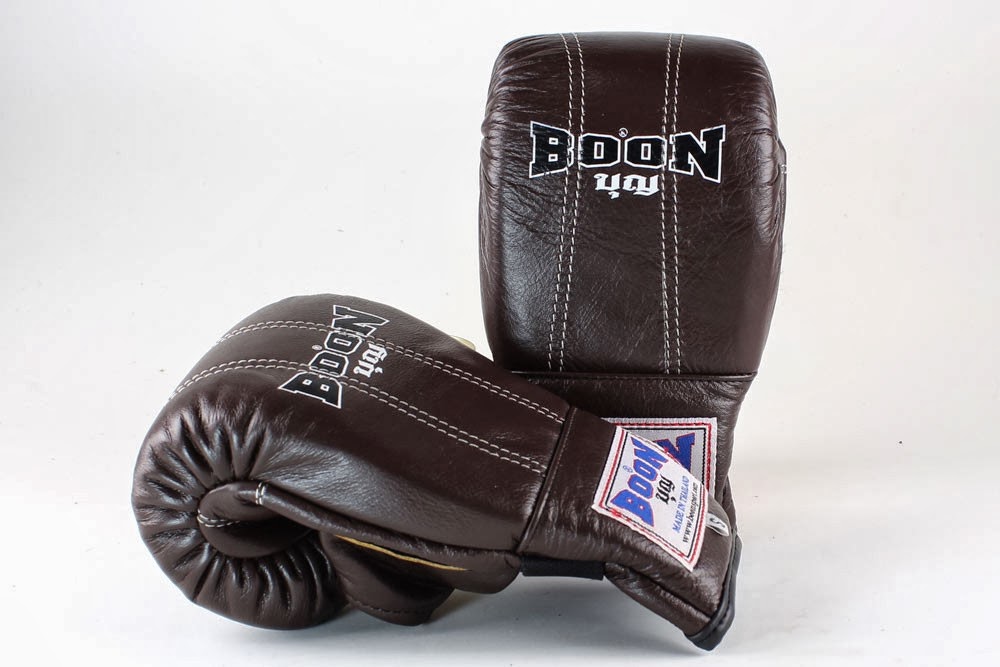

For MMA class, an athlete should choose a glove that has either a Hook-and-loop or elastic cuff. In class you are often partnered up for pad/bag work and need to be able to transition quickly as not to cut into your partner’s pad time.
A commonly asked question I get is, “I can only afford one pair coach. Which ones should I get?”
100% of the time -Training gloves. Training gloves can serve dual roles as sparring and bag gloves but it’s important to remember that the more bag work you do with them, the more quickly they will break down and provide less protection when sparring. It’s very important to pay attention to the leather of the glove. Bag work/pad work is naturally abrasive and that is going to wear down the leather over your glove’s knuckles - the same place you are trying to strike with. Small cracks and tears in the leather can cause injury to your training partner when the punch hits skin. To help with this, occasionally take a little dab of petroleum jelly and rub it into the gloves to keep the leather pliable before class and reduce friction, and wipe them dry after class for storage and to remove any sweat and oils from training.
3. MMA Training gloves

This is the glove that my MMA students wear when they are doing light striking, clinch fighting (including “dirty boxing”) takedowns and ground work. The gloves have an open palm and allow the MMA athlete to have full use of his grip during grappling. The most significant difference between MMA Training gloves vs. MMA Fighting gloves are the fingers. MMA Training gloves do not have individual fingers. Instead there is a large, single pad covering the knuckle area with a single seam or protective piping along the bottom edge of the 2nd digits of the hand. This is often called a “Shooto” style design. This allows the athletes to strike with light to medium contact and train safely while engaging in striking and grappling. MMA Fighting gloves are lighter in weight 4-5oz. and have individual fingers. Why is this an issue? In some fight gloves, there is a sharp edge on each corner of the finger, making 8 very sharp edges at the end of your second digit. With this design problem, even light strikes can cause scratches and cuts that can ruin an otherwise good training practice, even possibly blinding your training partner if you were to cut his eye.
*Note I have been noticing that many manufacturers are aware of the design problem and are now tapering down the edges and sealing them with piping which is much better, however they are still lighter and offer less protection. MMA training gloves allow athletes to raise the contact level if necessary, allowing athletes to integrate grappling and striking.
Shinguards

While all of our bagwork and padwork is done without shin guards for the purposes of conditioning, when it is time to spar with kicks, shinguards are a must. For MMA which involves kick catches and takedowns integrated with striking, I’m very partial to the MMA/grappling style shinguards which have a neoprene backing across the calf. This backing keeps the shin guards in place where the conventional striking guards would twist or slide and the sparring would have to be stopped to adjust. Some students ask about the slip-on style shinguards. In my opinion they might be acceptable for very light sparring, they are not substantial enough to use for heavier contact. Why buy two pairs of shin guards?

While all of our bagwork and padwork is done without shin guards for the purposes of conditioning, when it is time to spar with kicks, shinguards are a must. For MMA which involves kick catches and takedowns integrated with striking, I’m very partial to the MMA/grappling style shinguards which have a neoprene backing across the calf. This backing keeps the shin guards in place where the conventional striking guards would twist or slide and the sparring would have to be stopped to adjust. Some students ask about the slip-on style shinguards. In my opinion they might be acceptable for very light sparring, they are not substantial enough to use for heavier contact. Why buy two pairs of shin guards?
That completes my list of essential gear for MMA sparring.
But wait coach.. “What about headgear?”
Ah headgear.. The subject brings up a very complicated topic for me regarding sparring, in which I hope to discuss in a future blog. For now I’ll give you the “Reader’s Digest version” of my philosophy regarding headgear.
a. You want it? Wear it! I fully understand many people have conditions which make it a must. Do what you must to train well, train safe, and train fun. Are you going to engage in a lot of hard boxing and kickboxing sparring? Wear it!
b. I've noticed something over the years. When headgear is worn, the contact level goes through the roof and the skill level of the sparring drops dramatically. Instead of mutual respect and control, it becomes “rock ‘em, sock ‘em robots”. Notice that boxing headgear is thick around the eyebrows and cheekbones and has little to no padding over the chin. Headgear is designed to prevent accidental cuts, it will not prevent knock outs!
c. Clinching while wearing headgear is just awful! With pure boxing or kickboxing it’s fine, but when you begin to grab the head or a collar tie as in muay thai and MMA, it is almost impossible for it to stay secured.
If you are local to the Northern Virginia/Washington DC metro area you should stop by the NHBGear Pro Shop in Herndon VA. The owner, Sam Kim, is very knowledgeable about all of the equipment I've listed and typically has several versions of each component, ex. multiple types of training gloves, MMA gloves, shinguards etc. For anyone interested in combat sports, walking into his shop is like a kid in a candy store! He's got everything you'll need.
If you have any comments or questions, I’d love to hear from you.
As mentioned above, my next blog will discuss sparring - purpose, intensity, contact, etc.
Stay safe, Have Fun!
Tuesday, January 4, 2011
An excellent write up about the Fairfax Jiu-Jitsu MMA Team!

MMAinDC.com writes a second story on our academy, this one focusing on MMA.
http://www.mmaindc.com/fairfax-mma-class/
MMA in DC comes to Fairfax Jiu-Jitsu
Local MMA reporter Reggie Esteban stopped by the Fairfax Jiu-Jitsu academy on a Saturday to meet the team and take a tour of our school.
http://www.mmaindc.com/fairfax-jiu-jitsu/
http://www.mmaindc.com/fairfax-jiu-jitsu/
Subscribe to:
Posts (Atom)